
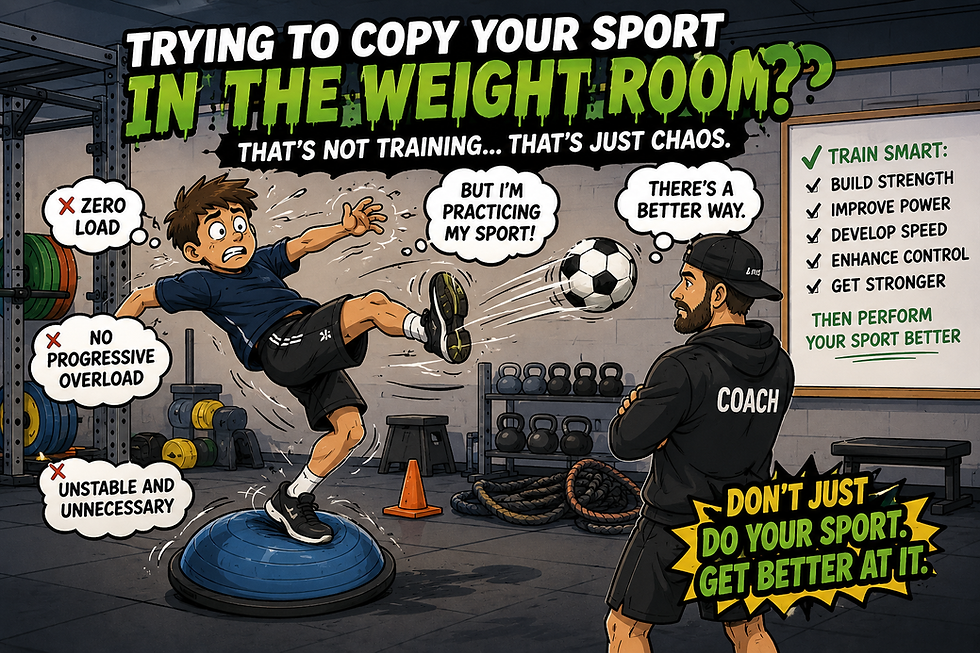
If your workout looks exactly like your sport… it’s probably not making you better at it.

“Sport-specific training” gets overused.
You’ll hear things like:
“If it doesn’t look like the sport, it’s not useful.”
“My kid plays soccer, they should train like soccer players.”
“We need to make the gym more game-like.”
But trying to mimic your sport in the weight room is not the goal.
The most sport-specific thing you can do is play your sport.
What actually builds performance
The weight room exists to build the foundation that allows you to express skill better, strength, power, speed, and resilience.
When we try to combine skill and physical training into one “sport-like” drill, both usually get diluted. You lose intent in the lift, and you lose quality in the movement.
Instead, we get more out of athletes by training one quality at a time and executing it with full intent.
SAID principle (why this matters)
SAID stands for Specific Adaptation to Imposed Demands.
A classic paper by Behm & Sale (1993) highlights that adaptations are driven by the demands placed on the body (especially force and intent) not by whether a movement visually resembles sport.
In other words:
Your body adapts specifically to what you consistently train.
What does this mean
A sled push doesn’t resemble perfect sprinting mechanics.
An upper body pull in the gym doesn’t replicate the coordination of an explosive throw.
But that’s not the point.
What matters is whether these exercises improve:
force production
rate of force development
overall strength
These physical qualities raise our ability to express skill in sport.
If we build the “buckets” in the weight room and combine that with consistent skill work on the field or court, those two together create a powerful performance base.
From there, we can get more specific by targeting different parts of the force–velocity curve depending on the demands of the sport and athlete needs (something we’ll break down more in future posts).
Where sport-specific training fits in
That said, there is still a place for sport-specific elements at times, especially with certain age groups or athletes.
In some cases, adding a small degree of sport context can improve:
Intent
Engagement
Movement quality under effort
For example, with a lacrosse player, simply having them hold their stick during select drills can increase intent and output compared to removing it completely. The movement itself doesn’t need to fully replicate the sport; it just needs to enhance the athlete’s focus and effort in that moment.
Bottom line
The goal is not to turn the entire weight room session into a replica of sport.
We’re simply choosing the right exercises and constraints that produce the highest intent, highest output, and best training effect, while keeping the focus on developing the underlying physical qualities that actually transfer.
Reference
Behm, D. G., & Sale, D. G. (1993). Intended rather than actual movement velocity determines velocity-specific training response. Journal of Applied Physiology, 74(1), 359–368. https://doi.org/10.1152/jappl.1993.74.1.359


Comments